


Introduction
Hyderabad’s booming tech economy has made it a hotspot for e-commerce, SaaS platforms, and fintech startups. With this digital surge comes a pressing need for IT Act compliance. The Information Technology Act, 2000 (IT Act), serves as the foundation of India’s cyber law framework, governing how online businesses must operate legally and securely.
This comprehensive guide breaks down the key legal obligations under the IT Act, 2000, and explains what every Hyderabad-based online business must do to stay compliant, secure, and successful in today’s digital economy
What Is the IT Act, 2000?
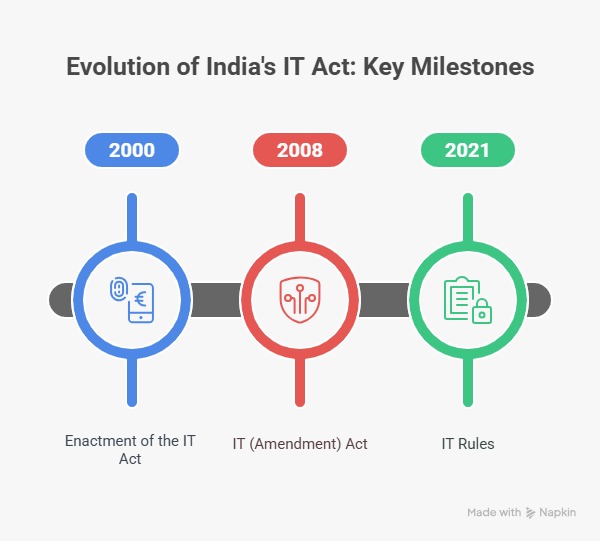
The Information Technology Act, 2000 was enacted to provide legal recognition to electronic transactions and digital signatures. It also outlines punishments for cybercrimes and data breaches, serving as the foundation of India’s digital legal system.
Key Objectives of the IT Act
- Grant legal status to electronic records and digital signatures
- Define cyber offenses and specify penalties
- Establish rules for certifying authorities
- Provide a framework for data privacy and cybersecurity
Major Amendments
- IT (Amendment) Act, 2008: Expanded to include cyber terrorism, phishing, and identity theft
- IT Rules, 2021: Mandated due diligence, grievance redressal, and transparency from digital platforms
Source: MeitY – Ministry of Electronics and Information Technology
Why the IT Act Matters for Hyderabad-Based Online Businesses
Hyderabad is a national tech hub and startup hotspot. As a result, local businesses must navigate intense competition and strict digital compliance standards.
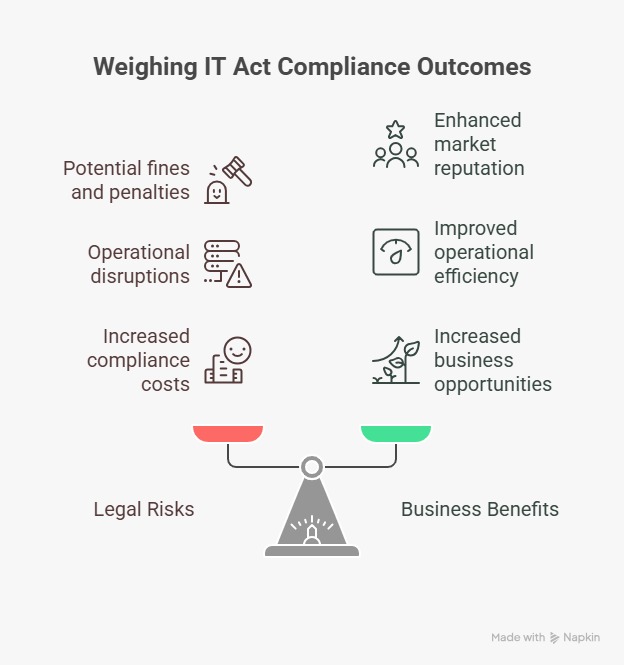
Legal Risks of Non-Compliance
- Heavy penalties for data breaches (up to ₹5 crore under Section 43A)
- FIRs and criminal liability under Sections 66 and 67
- Risk of platform takedown under the Intermediary Guidelines, 2021
Business Benefits of Compliance
- Builds customer and investor trust
- Enhances brand credibility
- Opens access to government tenders and funding programs
Example: In 2022, a Hyderabad-based fintech firm faced regulatory scrutiny over data handling. After adopting IT Act-compliant practices, the company restored investor confidence and gained new business.
Essential IT Act Provisions for Online Businesses
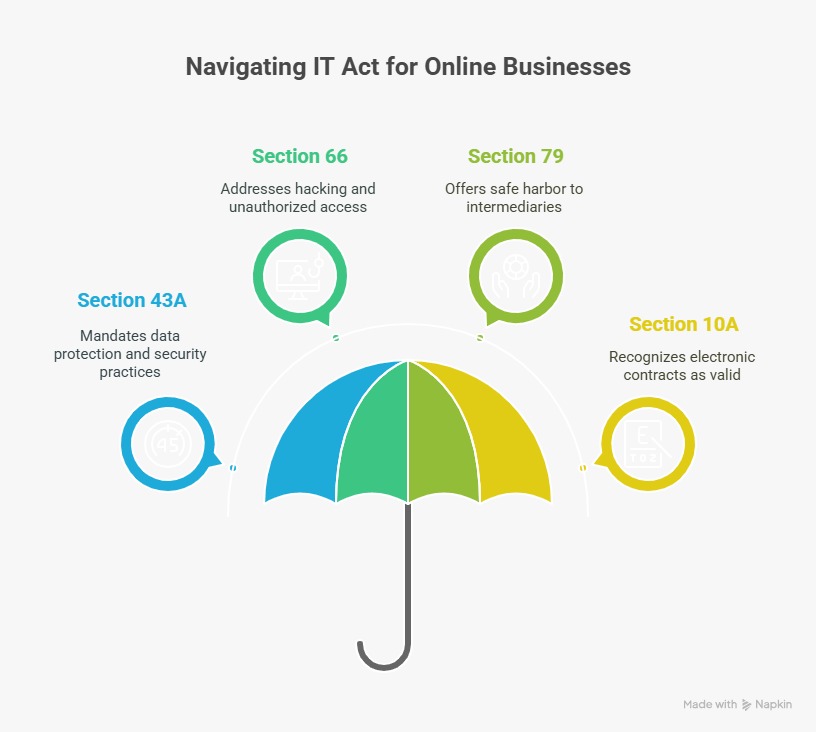
Here are the most critical sections of the IT Act that directly impact online operations:
Key Sections to Know
- Section 43A: Mandates data protection and “reasonable security practices”
- Section 66: Addresses hacking and unauthorized access to data
- Section 79: Offers safe harbor to intermediaries (e.g., e-commerce platforms) that follow due diligence
- Section 10A: Recognizes electronic contracts as legally valid
Application Example
E-commerce platforms like Flipkart and Amazon India ensure compliance by:
- Appointing compliance officers
- Displaying clear privacy and return policies
- Using government-approved digital certificates
Common Mistakes That Violate the IT Act
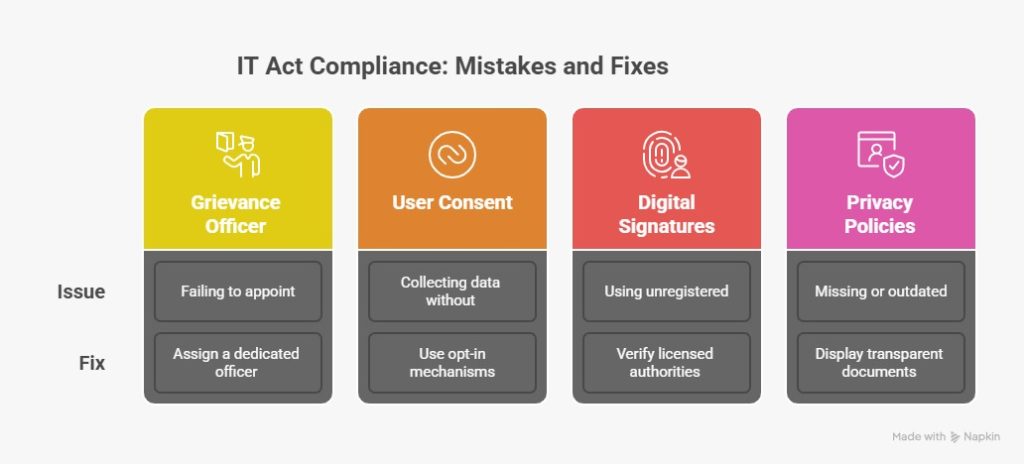
Many businesses unintentionally violate the IT Act due to lack of awareness. Common issues include:
- Failing to appoint a Grievance Redressal Officer
- Collecting personal data without explicit user consent
- Using unregistered digital signatures
- Missing or outdated privacy policies
Quick Fixes
- Assign a dedicated grievance officer, especially if you’re classified as an intermediary
- Use opt-in mechanisms and consent checkboxes
- Verify that all digital signatures come from licensed certifying authorities
- Display transparent legal documents like Terms of Use and Privacy Policy
Step-by-Step Compliance Checklist
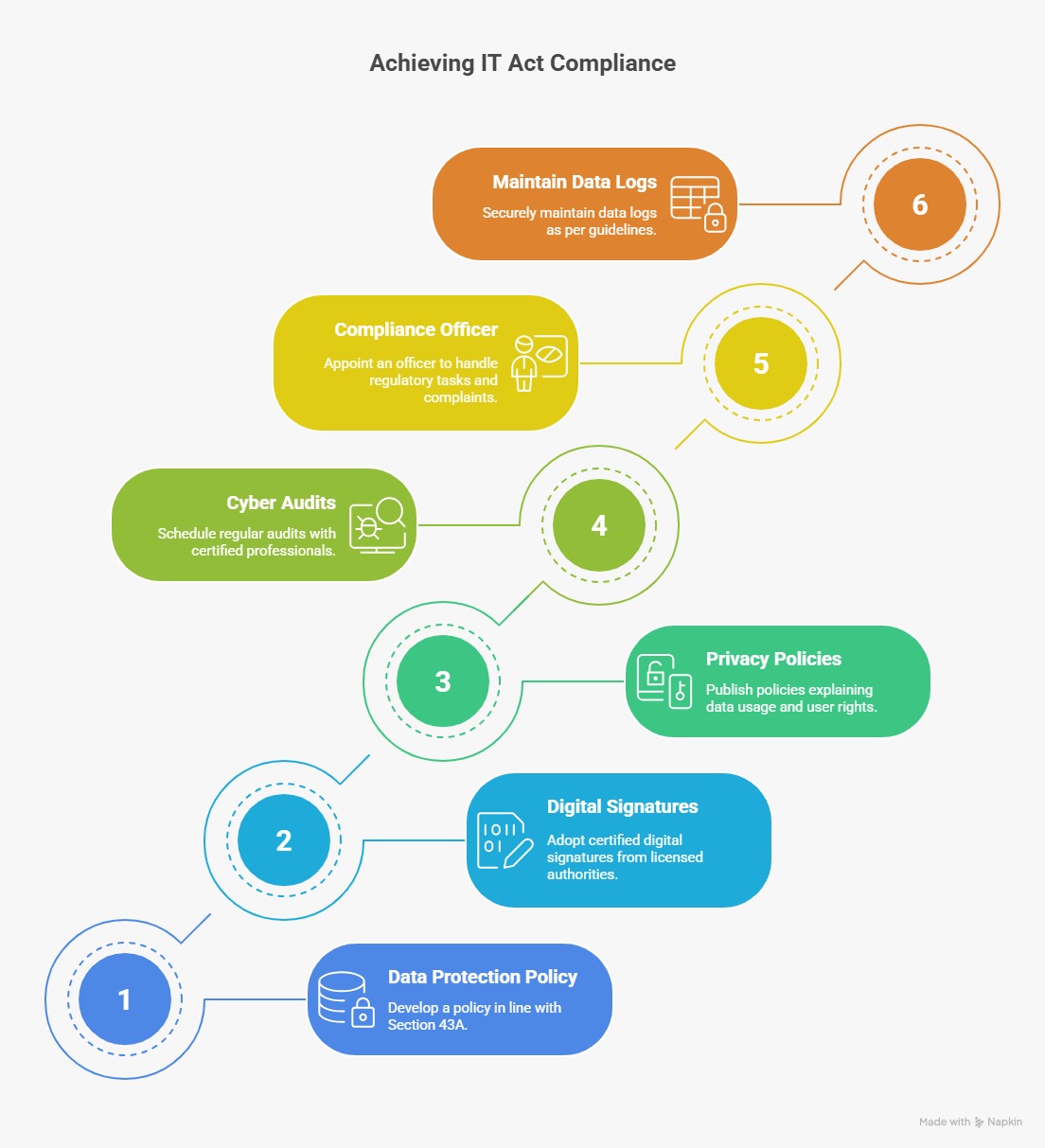
Step-by-Step IT Act Compliance Guide for Hyderabad Businesses:
- Develop a Data Protection Policy in line with Section 43A
- Adopt Certified Digital Signatures from licensed authorities (e.g., eMudhra, Sify)
- Publish Privacy Policies that explain data usage and user rights
- Schedule Regular Cyber Audits with certified professionals
- Appoint a Compliance Officer to handle regulatory tasks and complaints
- Securely Maintain Data Logs as per the government’s cybersecurity guidelines
Pro Tip: Use ISO/IEC 27001 standards as a benchmark for information security.
Legal and Cyber Law Resources in Hyderabad
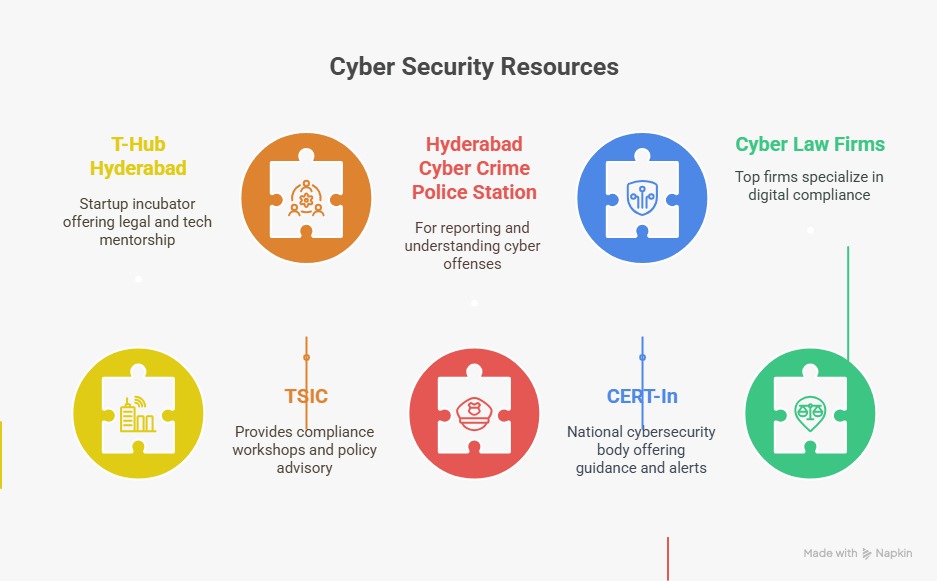
Top Cyber Law Resources in Hyderabad for IT Act Compliance:
- T-Hub Hyderabad: Startup incubator offering legal and tech mentorship
- TSIC (Telangana State Innovation Cell): Provides compliance workshops and policy advisory
- Hyderabad Cyber Crime Police Station: For reporting and understanding cyber offenses
- CERT-In (Indian Computer Emergency Response Team): National cybersecurity body offering guidance and alerts
- Cyber Law Firms: Top firms like Nishith Desai Associates and Fox Mandal specialize in digital compliance
Conclusion
Cyber law compliance is essential for every online business in Hyderabad. The IT Act, 2000 is more than just legal jargon—it’s a crucial framework that governs how digital operations must function lawfully.
Whether you’re running a digital storefront, launching a new app, or collecting customer data, IT Act compliance isn’t optional. Following the legal strategies outlined here will help you protect your business, build trust, and ensure sustainable growth in India’s digital economy.
Concerned about your compliance status? consult a certified cyber law expert to safeguard your business today.
Stay secure. Stay compliant. Stay ahead.

Did you know that over 30% of medical device certification delays stem from common regulatory oversights? Securing CE Class IIa certification is a critical milestone for manufacturers aiming to enter the European market—but even minor missteps can cost months of lost revenue and compliance setbacks. However, navigating the requirements of the EU Medical Device Regulation (MDR 2017/745) can be challenging. Missteps in the certification process often lead to costly delays, audit failures, or outright denial of market access. In this guide, we reveal the seven most common mistakes companies make when applying for CE Class IIa certification—and how you can avoid them.

- Misunderstanding CE Class IIa Certification Requirements
One of the most frequent missteps is underestimating the specific requirements for CE Class IIa certification under MDR. Many manufacturers mistakenly assume that CE marking follows a generic, one-size-fits-all checklist.
Key Points:
- CE marking varies by device classification and risk level.
- Class IIa devices require a conformity assessment by a Notified Body.
- Manufacturers must demonstrate safety and performance across the entire product lifecycle.
Solution: Thoroughly review MDR 2017/745 and consult with regulatory experts to fully understand the CE Class IIa certification process.
- Incorrect Product Classification
Misclassifying your medical device can significantly delay CE certification—potentially halting your EU market access. An incorrect classification leads to the wrong conformity assessment route, missing documentation, and added scrutiny from Notified Bodies. Classification determines the conformity assessment route, required documentation, and whether a Notified Body must be involved.
Common Errors:
- Making assumptions without referencing MDR classification rules.
- Mislabeling a Class IIa device as Class I or IIb.
Solution:
- Refer to MDR Annex VIII for classification rules.
- Use MDCG 2021-24 for practical guidance.
- Consult a Notified Body or regulatory specialist to validate your classification.
- Incomplete or Poorly Organized Technical Documentation
Technical documentation, or the technical file, forms the foundation of your CE application.
To enhance clarity and completeness, ensure your technical file includes:
- Device Description and Specifications: Define intended purpose, variants, and design drawings.
- Risk Management Documentation: Demonstrate risk analysis and mitigation per ISO 14971.
- Clinical Evaluation Report (CER): Present benefit-risk analysis and supporting clinical data.
- Manufacturing Process and Product Verification: Outline procedures and quality controls.
- Labeling and Instructions for Use (IFU): Include all packaging, symbols, and usage details in accordance with MDR guidelines.
These elements are required under MDR Annex II and III and should be kept up to date throughout the device lifecycle. Many companies fail to compile complete or well-structured documentation, resulting in delays or outright rejection.
Essential Components (per MDR Annex II & III):
- Device description and specifications
- Risk management documentation (aligned with ISO 14971)
- Clinical evaluation report (CER)
- Manufacturing process and product verification
- Labeling, packaging, and Instructions for Use (IFU)
Solution:
- Use a checklist based on MDR Annexes to build your technical file.
- Keep documentation up to date throughout the product lifecycle.
- Perform regular internal audits to ensure compliance.
- Assuming FDA Approval Equates to CE Certification
Many U.S.-based companies believe that FDA 510(k) clearance or PMA approval will ease CE marking. For example, a U.S. manufacturer of orthopedic implants that had already obtained FDA 510(k) clearance assumed their technical file would satisfy EU MDR requirements. However, they encountered a six-month delay because their clinical evaluation lacked the rigorous data needed under MDR, particularly regarding European patient populations and post-market surveillance obligations. However, the FDA and EU MDR frameworks differ significantly.
Key Differences:
- FDA is rule-based; MDR is risk-based.
- FDA focuses on predicate devices; MDR emphasizes clinical evidence and lifecycle safety.
- Post-market surveillance requirements differ significantly.
Solution:
- Treat CE certification and FDA approval as separate regulatory pathways.
- Tailor documentation specifically to EU MDR requirements.
- Avoid reusing FDA submissions without significant adaptation.
- Inadequate Clinical Evaluation Report (CER)
A weak or outdated Clinical Evaluation Report is a critical barrier to CE approval. The MDR mandates comprehensive, evidence-based clinical evaluations for all Class IIa devices.
Common Pitfalls:
- Failing to justify equivalence with other devices.
- Incomplete or outdated literature reviews.
- Non-compliance with MDR Annex XIV and MEDDEV 2.7/1 Rev. 4.
Solution:
- Prepare a robust CER that includes benefit-risk analysis, literature review, and clinical data.
- Ensure equivalence claims are backed by access to technical documentation.
- Have clinical experts review and validate your evaluation.
- Weak Post-Market Surveillance (PMS) Planning
Post-market surveillance (PMS) is often treated as an afterthought, yet it’s a core requirement under MDR. A weak PMS plan can undermine your compliance and affect your ability to detect emerging risks.
MDR PMS Requirements for Class IIa Devices:
- Proactive PMS Plan (Article 83)
- Post-Market Clinical Follow-up (PMCF), if needed
- Periodic Safety Update Reports (PSUR) every two years
Solution:
- Integrate PMS into your Quality Management System (QMS).
- Collect real-world data to inform CER updates and risk assessments.
- Monitor relevant adverse event databases and industry trends.
- Delaying Engagement with a Notified Body
Delaying contact with a Notified Body can derail your CE certification timeline. Under MDR, these bodies are responsible for auditing and approving Class IIa devices.
Why Early Engagement is Crucial:
- Limited capacity among Notified Bodies causes scheduling delays.
- Early discussions clarify requirements and expectations.
- MDR mandates a QMS audit for Class IIa devices.
Solution:
- Identify a designated Notified Body early in the process.
- Conduct a gap analysis before initial engagement.
- Allocate time and resources for the conformity assessment process.
Final Thoughts: How to Avoid CE Class IIa Certification Pitfalls
Navigating CE Class IIa certification under MDR is more than a paperwork exercise—it demands a strategic approach to compliance, safety, and performance.
By avoiding the seven common mistakes outlined above, you can:
- Reduce time to market
- Minimize audit failures
- Avoid costly rework and delays
Quick Recap:
- Understand MDR requirements thoroughly.
- Classify your product accurately.
- Maintain comprehensive and current technical documentation.
- Don’t rely on FDA approval alone.
- Develop a detailed, evidence-based CER.
- Plan and implement effective PMS activities.
- Engage your Notified Body as early as possible.
Call to Action
Preparing for CE Class IIa certification? Don’t leave it to chance—schedule a free consultation with our regulatory experts today and get personalized guidance through every step of the MDR compliance process. Book a Consultation Partner with a regulatory affairs expert to:
- Assess your readiness
- Review your technical documentation
- Guide you through conformity assessment
Set your device up for EU market success with a compliance strategy built to last.
FAQs
Q1: Is the IT Act, 2000 applicable to small online businesses?
Yes, the Act applies to all businesses—regardless of size—if they collect user data or operate digital platforms.
Q2: What are the penalties for violating the IT Act?
Fines can go up to ₹5 crore depending on the offense, along with possible imprisonment for serious violations.
Q3: How can I verify if my website is compliant with the IT Act?
Conduct a legal audit or consult a certified cyber law specialist. CERT-In and MeitY also publish regular updates and best practices.
Read more at:
- https://www.meity.gov.in/
- https://www.cert-in.org.in/


