


Introduction — The Digital Health Gap India Must Close
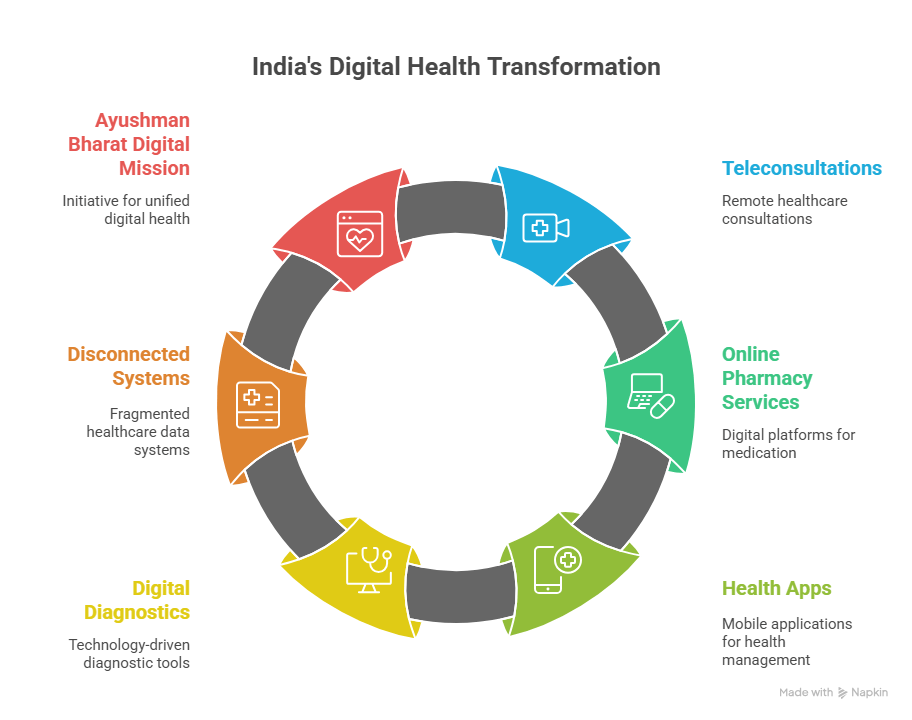
India’s digital health landscape is evolving at an unprecedented pace. With the rise of teleconsultations, online pharmacy services, health apps, and digital diagnostics, enormous volumes of patient information are being generated every day. Yet the majority of these records remain locked within disconnected systems—a hospital EMR that cannot read data from a pathology lab, a telemedicine platform unable to review previous clinical notes, or a pharmacy app that cannot verify prescriptions from another provider.
This fragmentation leads to incomplete medical histories, duplicated tests, delayed diagnoses, and poor continuity of care. Healthcare providers struggle without access to consolidated information, and patients juggle multiple formats and portals without a unified view of their own data.
The Ayushman Bharat Digital Mission (ABDM) seeks to close this gap by building a nationwide digital health ecosystem where information flows securely and seamlessly—but only with patient consent and only when systems follow defined data and technical standards.
This guide explains how organizations can build ABDM-compliant digital health record systems, integrate ABHA identity, adopt FHIR-based data structures, design for interoperability, and prepare for ABDM Sandbox certification. Whether you are a CTO, startup founder, hospital IT manager, or digital-health strategist, this blog offers a clear and practical roadmap for joining India’s unified health ecosystem.
- What Is ABDM? A Quick Primer for Developers & Health Leaders
Before you begin building or upgrading your digital health systems, it’s important to understand what ABDM is designed to achieve and how its building blocks work together.
What is ABDM?
The Ayushman Bharat Digital Mission, launched by the Ministry of Health & Family Welfare, provides the foundation for a secure, interoperable digital health infrastructure across India. It establishes a nationwide framework for how health data should be created, stored, shared, and accessed in a standardized, consent-driven manner.
At its core, ABDM ensures:
- Standardized health data formats
- Consent-based data exchange
- Decentralized record-sharing
- Verified digital identities for patients and providers
Key ABDM Building Blocks
- ABHA (Ayushman Bharat Health Account)
A unique, patient-centric digital identity that allows health records to be linked and retrieved across different systems—no matter where they were generated.
- Health Facility Registry (HFR)
A verified directory of hospitals, clinics, labs, imaging centers, and other healthcare facilities across India.
- Healthcare Professionals Registry (HPR)
A standardized registry of doctors, nurses, pharmacists, and other licensed healthcare professionals.
- Health Lockers (HRPs)
Secure digital vaults where individuals can store, access, and manage their personal health records.
Understanding ABDM Roles
- HIP (Health Information Provider):
Entities that generate patient data—hospitals, clinics, labs, pharmacies. - HIU (Health Information User):
Entities that request access to health records for treatment or related purposes. - HRP (Health Record Provider):
Digital lockers where patients store and retrieve their records.
What ABDM Compliance Involves
To be compliant, systems must:
- Use FHIR-based data formats
- Support ABHA identity creation and linking
- Integrate with ABDM’s APIs for consent and record sharing
- Implement strong security and privacy protocols
- Successfully clear Sandbox testing
Compliance is both a technical requirement and a strategic advantage in a rapidly modernizing healthcare environment.
III. Why ABDM Compliance Matters: Benefits for Providers, Patients & Tech Teams
Adopting ABDM standards brings benefits at every level of the healthcare ecosystem—far beyond meeting regulatory expectations.
- True Interoperability
ABDM ensures everyone speaks the same digital language. Using FHIR-based formats, systems can seamlessly exchange information, enabling:
- Instant retrieval of lab reports across cities
- Access to complete medical histories in teleconsultations
- Verification of digital prescriptions at pharmacies
Interoperability becomes effortless instead of a long-term integration challenge.
- Empowering Patients With Data Ownership
ABDM is built on a consent-first model. Patients decide what information to share, with whom, for what purpose, and for how long. This improves trust, transparency, and comfort with digital health platforms.
- Integration With Public Health Programs
ABDM lays the groundwork for integrating national health schemes and simplifying operations such as claims processing, facility verification, and fraud detection.
- Improved Continuity of Care
With consolidated patient records, clinicians gain access to:
- Lab trends
- Past medical history
- Prescriptions
- Imaging results
- Hospitalizations
This reduces redundancy, improves accuracy, and ensures more informed clinical decisions.
- Competitive Advantage for Digital Health Platforms
Compliance enhances credibility, simplifies partnerships, and future-proofs products. Early adopters gain an edge as ABDM becomes the backbone of India’s health-tech ecosystem.

- Understanding ABDM Data Standards (The Core of Compliance)
The most critical component of ABDM compliance is adherence to its data standard—HL7 FHIR.
- Why FHIR R4?
FHIR is a globally recognized standard designed for easy data exchange. It offers:
- Machine-readable, structured data
- REST API compatibility
- JSON/XML formats
- Modular resource-based models
ABDM uses FHIR R4 with customized profiles to meet India-specific requirements.
- ABDM FHIR Profiles & HI Types
ABDM defines multiple Health Information (HI) Types, including:
- Prescriptions
- Lab results
- Diagnostic reports
- OPD notes
- Discharge summaries
- Immunization records
- Imaging data
Each HI Type corresponds to a defined set of FHIR resources—ensuring consistency across systems.
- Mandatory Fields Developers Often Miss
Some elements are non-negotiable:
- ABHA ID
- Encounter timestamps
- HFR and HPR identifiers
- Record type (HI Type)
- Provenance metadata
- Consent transaction details
Missing these fields will result in Sandbox test failures.
- NRCeS Data Dictionary
The NRCeS serves as your blueprint for accurate mapping and implementation. It provides:
- FHIR mappings
- Sample payloads
- Reference tables
- Detailed implementation guidelines
Using it early helps avoid rework and accelerates certification.

- How to Build ABDM-Compatible Digital Health Records Systems
Now let’s translate the standards into a practical development roadmap.
Step 1: Architect the Data Layer
Transitioning from custom schemas to FHIR-compatible structures requires:
- Auditing Existing Data
List all clinical entities—patient details, visits, prescriptions, notes, labs, vitals, imaging, and more.
- Mapping to FHIR
Link each database entity to relevant FHIR resources such as:
- Patient
- Encounter
- Observation
- DiagnosticReport
- Practitioner
- Organization
- Deciding Your Storage Model
Options include:
- Storing data natively in FHIR
- Maintaining your schema and converting to FHIR during exchange
Choose based on scalability and internal architecture.
Step 2: Implement ABDM’s Consent Framework
ABDM’s consent system is central to secure data sharing.
How Consent Works
- HIU requests consent
- Patient receives and reviews a request
- Patient approves or denies
- Approved consent generates an artefact
- HIP shares data referencing that artefact
Design a Clear Consent UX
- Avoid medical jargon
- Clearly state purpose, duration, and data types
- Allow easy withdrawal
- Provide confirmation prompts
A clean user experience improves adoption and reduces abandonment.
Step 3: Integrate ABHA Identity
ABHA is mandatory for linking health records.
Your system must support:
- ABHA creation
- ABHA login
- Linking records to ABHA addresses
- Deduplicating patient profiles
A smooth ABHA experience increases interoperability and reduces conflicts in identity matching.
Step 4: Enable API Integration & Interoperability
ABDM’s Gateway enables secure, decentralized data exchange.
Your architecture must support:
- HIP-to-HIU data flows
- Consent requests & responses
- Health locker interactions
- Secure endpoints
- Standardized error handling
Adopt RESTful APIs, high-availability patterns, and secure authentication mechanisms.
Step 5: Strengthen Security, Privacy & Compliance
ABDM’s privacy framework reinforces patient safety.
Key Requirements
- TLS 1.2+ encryption in transit
- AES-256 at-rest encryption
- Role-based access controls
- Comprehensive audit trails
- Secure backup and retention policies
Compliance isn’t just about ticking boxes—it’s essential for responsible health data management.
Step 6: Test & Certify Through ABDM Sandbox
Before going live, all systems must pass Sandbox certification.
Common Failure Points
- Incorrect FHIR mappings
- Missing mandatory fields
- Timezone mismatches
- Wrong provenance data
- Faulty ABHA linking
Running internal QA and validation tools early helps avoid last-minute rejections.
- Case Studies: ABDM in Action
Case Study 1: eSanjeevani Telemedicine
By adopting ABDM standards, eSanjeevani enabled:
- ABHA-linked teleconsultation records
- Seamless prescription sharing
- Retrieval of patient history across states
Today, millions of consultations flow smoothly through ABDM-compliant formats.
Case Study 2: A Private Hospital Network
A mid-sized hospital group adopted ABDM-compliant OPD workflows and saw:
- Faster registrations
- Fewer clinical errors
- Improved patient experience
- Better alignment with insurers
ABDM integration improved both patient satisfaction and operational efficiency.
Case Study 3: A Digital Health Startup
A chronic-care management platform implemented:
- FHIR-based data storage
- ABHA login
- Gateway-based record sharing
This significantly increased trust and attracted new partnerships from hospitals and insurers.
VII. Common Pitfalls to Avoid
Avoid these common issues when building ABDM-ready systems:
- Incomplete FHIR mappings
- Confusing consent interfaces
- Duplicate or unlinked ABHA identities
- Missing practitioner or facility metadata
- Poor scalability planning
- Skipped Sandbox pre-validation
Being aware of these challenges early accelerates your compliance journey.
VIII. Conclusion — The Future of India’s Health Data Starts With Standards
India is building one of the world’s largest, most interoperable digital health ecosystems. To fully participate in this future, healthcare organizations must adopt modern, standardized approaches to identity, data exchange, and security.
Building ABDM-compliant digital health systems allows organizations to:
- Provide seamless, coordinated care
- Empower patients with full control over their data
- Integrate effortlessly with insurers and public programs
- Enhance trust and credibility
- Prepare for the next decade of digital health innovation
The question is no longer if organizations should adopt ABDM standards—but how quickly they can implement them.
If you’re building or modernizing healthcare technology, now is the perfect time to begin:
- Map data to FHIR
- Adopt ABHA identity
- Implement consent-based sharing
- Begin Sandbox testing
India’s digital health revolution is underway—and those who embrace interoperability today will shape the healthcare systems of tomorrow.
📞 Contact us at support@virtrigo.com to book your free consultation and for your business compliant.


