


Why Compliance Alone Isn’t Enough
Hospitals in Telangana have made impressive strides in infrastructure, technology, and accreditation. Yet, patient experiences and outcomes still vary significantly. Many hospitals focus primarily on regulatory compliance — meeting checklists and achieving certifications. While important, compliance alone does not guarantee consistent high-quality care. True quality comes from embedding a culture where continuous improvement and patient-centered practices are part of everyday routines.
This post explores how hospitals in Telangana can transition from compliance-driven operations to a culture of quality. We will examine the principles of hospital quality culture, the role of continuous improvement, local healthcare insights, accreditation frameworks, case studies, and practical strategies for fostering lasting change. The goal is to provide actionable guidance for hospital administrators, healthcare professionals, and policymakers.

Understanding Hospital Quality Culture
Hospital quality culture represents the shared values, attitudes, and behaviors that prioritize patient safety, service excellence, and continuous improvement. Unlike compliance, which focuses on meeting external standards, a quality culture is ingrained in the way staff think, decide, and act every day.
Continuous Quality Improvement (CQI) lies at the heart of this culture. It involves identifying areas for improvement, implementing interventions, monitoring results, and refining processes based on feedback. By integrating CQI into daily routines, hospitals shift from reactive problem-solving to proactive enhancement of patient care.
A strong quality culture brings tangible benefits: improved patient satisfaction, better clinical outcomes, fewer errors, and greater staff engagement. Studies consistently show that hospitals embracing such a culture experience lower readmission rates, enhanced infection control, and increased patient trust.

The Telangana Healthcare Landscape
Telangana’s healthcare system has transformed over the past decade. Since its formation in 2014, the state has significantly increased healthcare investment, boosting the health budget from approximately ₹4,932 crore in 2015–16 to over ₹12,364 crore in 2023–24. This has enabled the establishment of new medical colleges, super-specialty hospitals, and upgraded district hospitals, improving access to care across the region.
Government initiatives like the welfare schemes have strengthened maternal and child health, promoting preventive care and follow-up. These programs support hospital quality culture by emphasizing patient-centered care.
Despite these advances, challenges remain. Resource disparities, staff turnover, and varying levels of training can hinder consistent care delivery. Nonetheless, Telangana’s healthcare system presents a strong foundation for embedding quality culture through strategic leadership, training, and data-driven improvement initiatives.
Frameworks and Accreditation Driving Quality
Accreditation and quality frameworks are essential for building sustainable quality culture in hospitals. In Telangana, several key systems guide hospitals toward excellence.
National Quality Assurance Standards (NQAS) provide a structured approach through internal assessor training programs. Trained assessors monitor compliance, identify improvement areas, and mentor staff, transforming accreditation from a checklist exercise into a platform for continuous learning.
Accreditation Bodies in India, such as NABH and QCI, reinforce quality standards. The Quality Council of India (QCI) further supports hospitals with evaluation tools and recognition programs that incentivize sustained excellence.
Through these frameworks, hospitals can standardize processes, institutionalize best practices, and cultivate an environment where quality is embedded in everyday operations.
Evidence-Based Insights: Patient Satisfaction and Outcomes
Research highlights the impact of quality culture on patient experiences. A study by Maragani Srinivas and P. Venkataiah at Osmania University examined how service quality affects patient satisfaction and loyalty in Telangana hospitals. Using the SERVQUAL tool, which measures reliability, tangibles, responsiveness, assurance, and empathy, 600 patients across seven hospitals were surveyed.
The study found a strong correlation between perceived service quality and patient satisfaction. Hospitals that embraced continuous improvement not only met clinical standards but also built trust and loyalty among patients. Another study in the South East European Journal of Public Health revealed that tangible aspects like cleanliness, infrastructure, and staff responsiveness significantly influenced patient perceptions.
These findings demonstrate that quality culture directly affects patient outcomes and organizational reputation. Hospitals in Telangana seeking excellence must address both clinical and experiential dimensions of care.
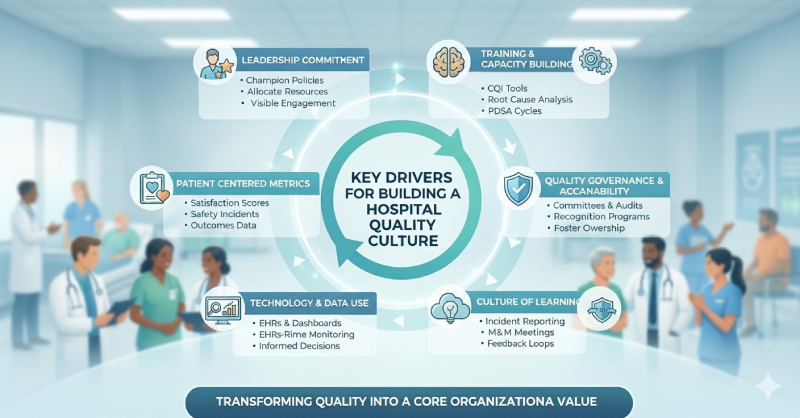
Key Drivers for Building a Hospital Quality Culture
Developing a sustainable quality culture requires attention to multiple factors:
- Leadership Commitment: Leaders must champion quality, demonstrating its importance through policies, resource allocation, and visible engagement.
- Training & Capacity Building: Staff should receive ongoing training in CQI tools, root cause analysis, and PDSA cycles.
- Patient-Centered Metrics: Hospitals should monitor satisfaction, safety incidents, readmission rates, and clinical outcomes.
- Quality Governance & Accountability: Committees, audits, and recognition programs foster ownership and accountability.
- Technology & Data Use: EHRs, dashboards, and analytics support real-time monitoring and informed decision-making.
- Culture of Learning & Safety: Encourage reporting of incidents and near misses, conduct regular morbidity and mortality meetings, and maintain feedback loops.
Integrating these drivers into daily operations helps transform quality from a regulatory requirement into a core organizational value.
Challenges and Barriers to Implementation
Hospitals often encounter several challenges when building a quality culture:
- Staff Turnover & Burnout: High turnover disrupts continuity and reduces institutional knowledge.
- Resource Constraints: Not all facilities have equal access to equipment, technology, or skilled personnel.
- Siloed Departments: Lack of cross-functional collaboration can hinder coordinated improvement efforts.
- Measurement Fatigue: Overemphasis on compliance metrics may lead to superficial adherence rather than meaningful improvement.
- Behavioral Resistance: Staff may perceive quality initiatives as extra work rather than core responsibilities.
Overcoming these challenges requires strong leadership, consistent training, staff engagement, and clear communication of the benefits of a quality culture.
Opportunities and Strategic Recommendations
Hospitals in Telangana can leverage several opportunities to strengthen their quality culture:
- Scalable Training Programs: Expand internal assessor and CQI training across all hospitals to build a uniform culture of quality.
- Embedding CQI in Routine Operations: Incorporate regular quality huddles, monthly reviews, and feedback loops.
- Leveraging Technology: Adopt interoperable EHR systems and dashboards to monitor metrics in real time.
- Peer Learning & Knowledge Sharing: Facilitate workshops, conferences, and collaborative platforms for sharing best practices.
- Leadership Development: Train hospital leaders in quality improvement, safety culture, and change management.
- Patient Engagement: Integrate patient feedback into decision-making to align improvement initiatives with patient needs.
By strategically focusing on these areas, hospitals can transition from compliance-driven operations to a robust, sustainable culture of quality that enhances both patient care and organizational performance.
Conclusion
Moving from compliance to culture is not merely an administrative exercise; it is a fundamental shift in how hospitals operate and deliver care. Telangana’s hospitals have the investment, frameworks, and local expertise to embed quality as a daily practice.
A strong culture of quality, underpinned by continuous improvement, leadership commitment, patient-centered metrics, and robust governance, leads to better outcomes, higher patient satisfaction, and sustainable growth. Hospitals that embrace this transformation not only meet regulatory requirements but also set new standards for healthcare excellence in India.
Call to Action: Is your hospital ready to move beyond compliance and make quality a part of every decision, every day? The time to act is now — because a culture of quality transforms not just hospitals, but the lives they touch.


