


Introduction: A New Dawn for Data Privacy in Hyderabad’s SaaS Ecosystem
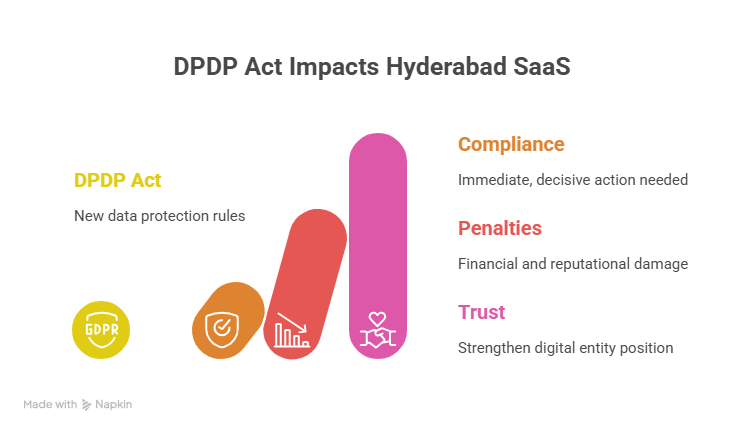
India’s digital landscape has entered a new era. The Digital Personal Data Protection (DPDP) Act Rules, 2025, are now officially finalized and notified by the Ministry of Electronics and Information Technology (MeitY). This landmark development redefines how businesses handle personal data nationwide, establishing a robust framework for digital trust and accountability.
For Hyderabad’s vibrant Software as a Service (SaaS) sector—a dynamic hub of innovation serving millions of Indian and global users—this is more than a regulatory update. It’s a pivotal moment demanding immediate, decisive action. The new rules significantly enhance the DPDP Act, clarifying obligations and introducing specific compliance mechanisms. As a Hyderabad-based SaaS company, you must understand and act on these rules promptly. Non-compliance now carries substantial financial penalties and potential reputational damage.
This comprehensive guide offers Hyderabad’s SaaS companies an urgent, actionable roadmap to navigate these new rules. We’ll break down the key changes, highlight immediate compliance priorities, and provide practical, step-by-step guidance. This will help your business achieve compliance and strengthen its position as a trusted digital entity.
Understanding the Finalized DPDP Act Rules 2025: Key Changes & Immediate Impact
The DPDP Act 2023 laid the groundwork, but the DPDP Act Rules 2025 provide the granular detail and operational clarity essential for implementation. These formally enacted rules represent the government’s definitive framework for data protection enforcement.
Key Additions and Clarifications for SaaS Businesses:
- Refined Consent Notice Requirements: Rules now mandate that notices for obtaining consent must be explicit, itemized, and independent for each specific data processing purpose. This demands clear, actionable transparency from SaaS providers, moving beyond generic privacy policies.
- Formalized Data Principal Rights: Rules detail precise mechanisms for individuals (Data Principals) to exercise their rights. This includes the Right to Erasure (to have their data deleted when no longer necessary) and the Right to Correction (to rectify inaccurate or outdated personal data). Your SaaS platform must seamlessly facilitate these requests.
- Specifics for Significant Data Fiduciaries (SDFs): Rules elaborate on additional obligations for SDFs. These may include conducting Data Protection Impact Assessments (DPIAs), undergoing regular compliance audits, and adhering to algorithmic fairness principles. While precise thresholds will come from the Data Protection Board of India (DPBI), many large or data-intensive Hyderabad SaaS companies serving a substantial user base could face classification as SDFs, incurring heightened responsibilities.
- Operationalization of the Data Protection Board of India (DPBI): Rules formalize the DPBI’s role as the primary enforcement authority. The DPBI is designed as a “digital office,” facilitating online complaint resolution and adjudication. Hyderabad SaaS businesses must prepare for all official interactions, including breach notifications and inquiries, to be conducted digitally.
- Clearer Data Breach Notification Timelines: While the Act mandated notification, rules now provide more precise expectations. Data Fiduciaries must notify the DPBI (and affected Data Principals) of any personal data breaches “without undue delay,” often interpreted as within 72 hours for detailed reports. This demands robust internal incident response plans.
- Formalized “Consent Manager” Framework: This unique element of India’s data protection landscape receives more detail in the rules. Consent Managers are DPBI-registered entities that can facilitate granular consent management for data principals across multiple Data Fiduciaries. SaaS providers can explore leveraging these certified platforms.
- Stricter Provisions for Children’s Data: Rules reinforce the requirement for “verifiable parental consent” when processing data of individuals under 18. They also explicitly prohibit tracking, behavioral monitoring, or targeted advertising towards children without specific governmental approval. SaaS platforms with younger user bases must exercise extreme caution.
Navigating the Immediate Implementation Timeline:
With the rules officially notified, the grace period for preparation is either very short or already passed for fundamental compliance aspects. While the DPBI may introduce a phased rollout for complex provisions (e.g., specific SDF audits), core obligations, especially concerning consent and data principal rights, are immediate. Hyderabad SaaS companies must prioritize these actions to mitigate non-compliance risks.
Immediate DPDP Compliance Checklist for Hyderabad SaaS
For SaaS companies in Hyderabad, a strategic, prioritized approach to compliance is essential. Here’s an actionable checklist to kickstart your efforts:
- Conduct a Rapid Data Audit & Mapping:
- Identify All Personal Data: Pinpoint every piece of digital personal data (especially of Indian Data Principals) your SaaS collects, stores, processes, or shares. This includes user profiles, behavioral data, communication logs, and payment information.
- Map Data Flows: Understand your data’s complete lifecycle—from collection (e.g., website forms, API integrations) to storage (e.g., cloud servers – are they in India or abroad?), processing (e.g., analytics, marketing automation), and sharing (e.g., third-party integrations, vendors).
- Hyderabad Specific: Many Hyderabad SaaS firms serve both domestic and international clients. Clarify if your data storage solutions (e.g., AWS, Azure, GCP) involve cross-border transfers and ensure compliance with any specific transfer restrictions.
- Review & Update Consent Mechanisms:
- Ensure “Free, Specific, Informed, Unambiguous” Consent: Your current consent forms (e.g., checkboxes, pop-ups) must clearly articulate what data is collected, why (purpose), and how it will be used. Generic “I agree to terms” is no longer acceptable under the DPDP Act.
- Implement Easy Withdrawal: Users must have a straightforward, intuitive way to withdraw consent at any time. Your systems must immediately cease processing for that purpose upon withdrawal.
- Update Privacy Notices: Meticulously update your privacy policy, terms of service, and any in-app privacy statements. They must reflect the new DPDP Act and Rules, providing itemized details and clear instructions on how Data Principals can exercise their rights.
- Establish a Robust Grievance Redressal Mechanism:
- Appoint a Point of Contact: Designate a clear point of contact (an individual or a dedicated team) for handling Data Principal grievances and requests. For larger SaaS, this may involve appointing a dedicated Data Protection Officer (DPO) based in India.
- Set Up Accessible Channels: Provide clear, user-friendly, and preferably digital channels (e.g., a dedicated email address, in-app support, a web form) for Data Principals to submit requests regarding their data rights (access, correction, erasure, nomination).
- Define Internal Processes: Create documented internal workflows for promptly receiving, verifying, responding to, and resolving Data Principal requests within stipulated (or reasonable) timelines.
- Bolster Data Security Safeguards:
- Implement “Reasonable Security Safeguards”: The Act mandates “reasonable security safeguards” to prevent personal data breaches. This includes strong encryption for data at rest and in transit, robust access controls (role-based access management), and regular security audits and penetration testing.
- Develop a Comprehensive Data Breach Response Plan: Create or refine a detailed plan for detecting, assessing, containing, and notifying the DPBI and affected Data Principals of any personal data breaches. Provide notifications within stipulated timelines (e.g., detailed reports to DPBI typically within 72 hours).
Consent Management for Hyderabad SaaS: User Experience Meets Compliance
For SaaS businesses, consent forms the bedrock of DPDP compliance. Yet, achieving compliance must not compromise user experience.
- Beyond the Checkbox: Designing for Trust:
- Clarity and Conciseness: Present privacy notices and consent prompts in plain, understandable language, avoiding legal jargon. Contextual consent (e.g., “We need access to your location to provide nearest service results”) proves more effective and trustworthy than generic statements.
- Granular Options: Empower users by offering individual consent for different data processing activities, rather than an all-or-nothing approach. This demonstrates respect for user autonomy and builds trust.
- Avoid “Dark Patterns”: Regulators increasingly scrutinize deceptive UI/UX elements that trick users into consenting or make withdrawal difficult. Such practices signal non-compliance.
- Exploring Consent Managers:
- The DPDP Act’s unique “Consent Manager” framework envisions regulated entities (registered with the DPBI) facilitating granular consent management for data principals across multiple Data Fiduciaries.
- Evaluate Partnership: Hyderabad SaaS companies should actively assess if partnering with an upcoming DPBI-registered Consent Manager streamlines their consent collection, management, and withdrawal processes, particularly for high-volume data processing. This could significantly reduce compliance overhead.
- Managing the Consent Lifecycle:
- Verifiable Records: Maintain meticulous, audit-ready records of all consents obtained. Include the date, time, method of consent, specific purpose, and the version of the privacy notice presented.
- Automated Updates & Reminders: Implement systems to automatically track consent validity, send re-consent requests when necessary (e.g., after policy changes or after a defined period), and efficiently manage consent expiration.
- Seamless Withdrawal & Deletion: Ensure your systems promptly cease processing for a specific purpose upon consent withdrawal and facilitate secure erasure of personal data as per the Data Principal’s Right to Erasure.
- Special Considerations for Children’s Data:
- The DPDP Act defines a “child” as any individual under 18 years.
- Verifiable Parental Consent: Processing children’s data requires explicit, verifiable parental consent. Rules are expected to detail mechanisms for this, possibly involving identity verification steps.
- Strict Prohibitions: Be acutely aware of outright prohibitions on tracking, behavioral monitoring, or targeted advertising aimed at children without specific government permission. SaaS platforms with younger user bases (e.g., EdTech, gaming) must exercise extreme caution.
Key Challenges & Hyderabad-Specific Considerations for DPDP Compliance
While the DPDP Act applies nationally, Hyderabad’s dynamic SaaS ecosystem faces unique operational and strategic challenges:
- Operational Integration & Resource Allocation:
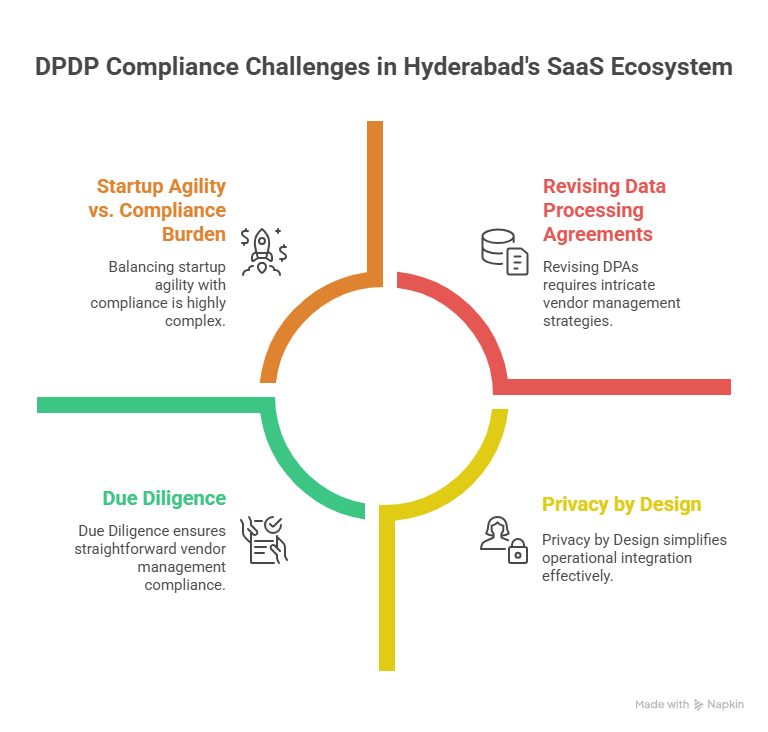
- Startup Agility vs. Compliance Burden: Hyderabad’s thriving startup scene often prioritizes rapid development and scaling. Integrating DPDP requirements into agile product development, especially for smaller teams with limited compliance personnel, can be a significant undertaking.
- Privacy by Design: Embed privacy considerations from the outset of product development—a “privacy by design” approach. This is crucial for avoiding costly retrofitting later. Train developers, product managers, and UI/UX designers accordingly.
- Compliance Costs: Investing in new tools (e.g., Consent Management Platforms, data mapping software), engaging legal counsel, and potentially appointing a DPO can represent a substantial financial commitment for early-stage or bootstrapped SaaS companies.
- Vendor & Third-Party Management:
- The Interconnected Ecosystem: SaaS companies rarely operate in isolation, relying on numerous third-party services (cloud hosting, analytics, marketing automation, payment gateways). Any vendor processing Indian personal data on your behalf becomes a “Data Processor” under the DPDP Act.
- Revising Data Processing Agreements (DPAs): Critically review and revise all existing and future contracts with relevant vendors to ensure DPDP Act compliance. Include explicit provisions for data security, data breach notification, audit rights, and assistance with Data Principal requests.
- Due Diligence: Conduct thorough due diligence on your vendors’ DPDP compliance posture. As the Data Fiduciary, you remain accountable for data processed by your processors.
- Data Retention & Erasure Timelines:
- Purpose Limitation: The Act emphasizes that personal data should only be retained for the “purpose for which it was collected” and no longer than necessary. This mandates a shift from indefinite data storage.
- Clear Policies: Develop and enforce transparent data retention policies. Ensure timely, secure erasure or anonymization of personal data when its original purpose is fulfilled or consent is withdrawn. This requires robust data lifecycle management within your SaaS platform.
- Classification as Significant Data Fiduciary (SDF):
- The Central Government can classify certain Data Fiduciaries as “Significant Data Fiduciaries.” This depends on factors like data volume and sensitivity, risk to Data Principal rights, and potential impact on India’s sovereignty and integrity.
- Increased Obligations: If your Hyderabad SaaS business is classified as an SDF, you face additional, stringent obligations. These include appointing a DPO based in India, conducting mandatory Data Protection Impact Assessments (DPIAs), and undergoing independent data protection audits. Many scaling SaaS companies could meet these criteria.
Beyond Compliance: Building Trust & Gaining a Competitive Edge
While avoiding penalties is a primary driver, Hyderabad SaaS companies have a tremendous opportunity to leverage the DPDP Act as a powerful strategic advantage.
- Compliance as a Trust Differentiator:
- In an increasingly data-conscious India, robust data protection practices are becoming a major selling point. Transparent data handling, clear privacy policies, and demonstrable respect for user rights can significantly enhance customer loyalty and bolster your brand’s reputation.
- For Indian consumers, a Hyderabad-based SaaS company proactively embracing data privacy fosters a deeper sense of security and trust. This can set you apart from less compliant competitors.
- Attracting Investment & Partnerships:
- For SaaS companies seeking growth or investment, demonstrable DPDP compliance is rapidly becoming a non-negotiable due diligence item for both domestic and international investors. It signals operational maturity, effective risk mitigation, and a sustainable business model in a regulated environment.
- Similarly, global partners looking to enter or expand in the Indian market will actively seek compliant Indian SaaS partners. They will view your adherence to DPDP as a crucial gateway to secure and trustworthy collaboration.
- Future-Proofing Your Business:
- The DPDP Act, while distinct, aligns India’s data protection landscape with global standards like GDPR. By building a strong DPDP compliance framework now, your SaaS business will be better positioned to adapt to future regulatory changes, whether in India or internationally.
- Foster a “privacy-first” culture within your organization. This proactive mindset, embedded from leadership down to every employee, ensures data protection becomes an intrinsic part of your operations. This leads to innovation within ethical boundaries.
Conclusion: Proactive Privacy is the Path Forward for Hyderabad SaaS
The finalization of the DPDP Act Rules 2025 marks a definitive moment for data privacy in India, placing significant responsibility on Data Fiduciaries like Hyderabad’s innovative SaaS companies. This is not merely a legal hurdle; it’s a foundational shift in how businesses must interact with personal data.
Your immediate action plan should center on meticulously understanding the nuanced rules, revamping consent mechanisms, strengthening data security measures, and formalizing grievance redressal processes. Proactive engagement with DPDP compliance will not only safeguard your business from substantial penalties. It will also serve as a powerful catalyst for building unparalleled customer trust, attracting vital investment, and cementing your position as a responsible, leading player in India’s booming digital economy.
Don’t wait for enforcement notices. Take control of your DPDP compliance journey today. Review current practices, consult with legal and privacy experts, and implement necessary changes. This ensures your Hyderabad SaaS business is not just compliant, but thrives in this new era of digital trust.
📥 Ready to Take Action?
📌 Need Help? Get a tailored audit for your SaaS platform – Schedule a 30-min Free Consultation or write us at support@virtrigo.com,


